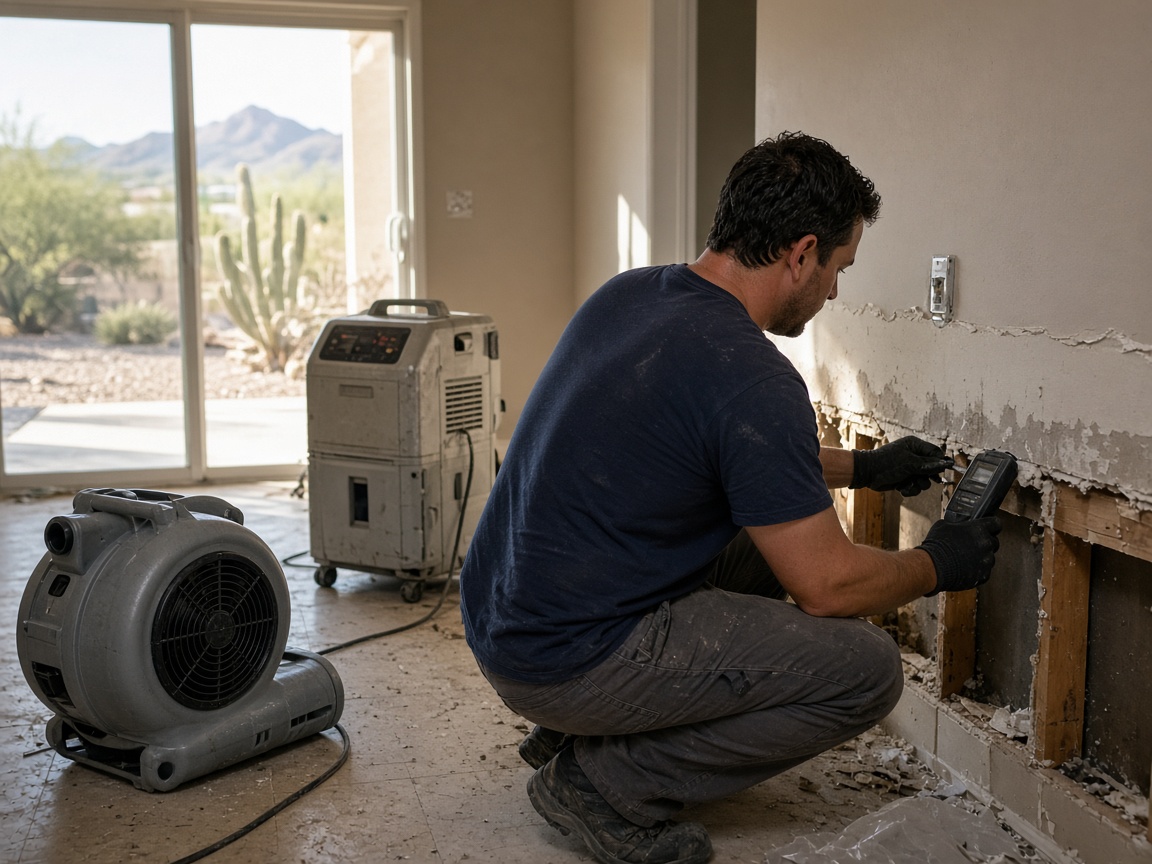
Phoenix summers push indoor humidity and temperatures so high that trapped moisture in wall cavities and subfloors can turn into active mold within 48 hours. Homes in older neighborhoods such as Maryvale and South Mountain often have gypsum plaster over lath or early plywood sheathing that absorbs water differently than modern materials, requiring slower, monitored drying rather than aggressive heat that can crack finishes. Technicians use moisture meters and thermal imaging to locate water that has wicked into stucco-clad walls common in Arcadia and Camelback East before setting up containment and drying equipment sized for the actual load.
Maricopa County building practices from the 1970s and 1980s left many single-story ranch homes with slab-on-grade construction and minimal vapor barriers. When monsoon runoff or appliance leaks saturate the slab edge, moisture travels laterally under cabinets and into adjacent rooms. Structural drying here means placing air movers at floor level and using low-grain dehumidifiers calibrated for 110-plus degree ambient conditions so that relative humidity stays below 50 percent without overheating the space and warping hardwood or laminate flooring found in Biltmore properties.
Nearby Scottsdale and Tempe homes built on former agricultural land can have higher soil moisture content that keeps concrete slabs damp longer after a leak. Drying crews must account for this by extending drying times and documenting moisture readings at multiple depths in the slab before any flooring replacement. Failure to do so often leads to recurring cupping or adhesive failure once the home returns to normal occupancy.
Technician insight
In Phoenix the thing that catches most people out with structural drying is how fast moisture travels laterally under slabs in older Maryvale and South Mountain homes once monsoon water or a leak hits the edge. Homeowners often stop at visible wet carpet and miss the slab moisture that later causes flooring failure months after the job.
Hidden Slab Moisture After Monsoon Leak
Water from a roof overflow entered a 1978 ranch home in Ahwatukee and soaked the slab edge under kitchen cabinets. Initial drying stopped at the visible floor. We mapped moisture extending three feet under the slab, ran floor-level air movers and low-grain dehumidifiers for six days, then verified readings before the homeowner reinstalled tile.
Structural Drying Services We Offer
✓Moisture Mapping and Documentation
Detailed meter readings and thermal scans of walls, floors and ceilings to locate hidden water before drying begins.
✓Low Grain Refrigerant Dehumidification
High-capacity units sized for Phoenix summer heat that pull moisture from cavities without raising room temperatures.
✓Directed Air Movement
Strategic placement of air movers to create airflow across wet structural materials in stucco and frame homes.
✓Slab Edge Drying
Targeted drying along concrete slab perimeters common in Maryvale and Ahwatukee ranch homes to stop lateral moisture travel.
✓Post Drying Verification
Final moisture meter checks and written reports confirming materials have returned to acceptable dry standards.
How it works
- 1
Initial Assessment
Technicians arrive within hours, document affected areas in neighborhoods such as Arcadia or Papago Park, and map moisture levels.
- 2
Containment Setup
Plastic barriers isolate wet zones to prevent humidity spread into unaffected rooms during extreme outdoor heat.
- 3
Equipment Placement
Air movers and dehumidifiers are positioned based on construction type and slab conditions typical in Maricopa County homes.
- 4
Daily Monitoring
Readings are taken each day and equipment adjusted until all structural materials reach dry standard.
- 5
Final Verification
Written report confirms moisture levels and equipment is removed once drying is complete.
Pricing
Cost depends on square footage affected, construction type, and how long water sat before discovery.